Patient Journey · Columbus, GA
When pain at the base of the hamstring has outlasted rest, stretching, and the usual rehab, it helps to know what a real evaluation looks like nearby. Here is how patients in the Columbus area typically move from a stubborn high hamstring tendon problem toward getting back to running, driving, and sitting comfortably again.
In Their Words
A TenJet patient describes chronic tendon pain and what the percutaneous procedure changed for them.
TenJet Patient Testimonial
Video courtesy of HydroCision, Inc., the maker of TenJet®. Individual results vary; this patient's experience is not a guarantee of outcome. Talk with a specialist about whether the procedure is appropriate for you.
Understanding The Condition
High hamstring tendinopathy affects the tendon where the hamstring attaches to the sit bone at the base of the pelvis. Pressing that tendon against the bone — as happens during long drives or on a hard seat — is a big part of why it aggravates so easily and heals so slowly. It is chronic tendon degeneration, not a fresh pull, which is why it needs a different approach than a routine muscle strain.
The Procedure
A structured, progressive loading program is the cornerstone of care and helps many patients recover. For those whose pain persists, Dr. Abdullah may discuss TenJet — a HydroCision, Inc. device that treats the degenerated tendon tissue directly, in the office, without the recovery burden of an open procedure to a deep area.
See The Procedure
A general demonstration from HydroCision of how the procedure works, plus a look at how a chronically degenerated tendon differs from one that is simply inflamed.
TenJet Patient Animation — How the Procedure Works


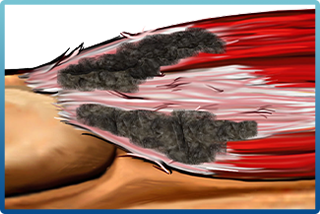
Diagrams and video courtesy of HydroCision, Inc.
What Care Looks Like
This is a general pattern, not a guarantee — your own path depends on your diagnosis and how your tendon responds.
It usually begins with deep sit-bone pain that hasn't settled with rest and stretching. An evaluation — often including ultrasound or MRI — confirms whether the proximal hamstring tendon is the source. Most patients then start with a carefully graded strengthening program that avoids aggravating positions. If the tendon stays symptomatic, an in-office, ultrasound-guided procedure is often considered before open surgery is discussed, followed by a gradual return to activity over several weeks.
Get Started
Call the office below to ask whether TenJet or another approach is the right next step for your hamstring pain.
Common Questions
Yes, in Columbus, Georgia, so patients in the area can be evaluated and treated without traveling to metro Atlanta.
Runners and sprinters are commonly affected because of repeated high-speed hip extension, but it also occurs in people who sit for long periods or do heavy lifting.
That varies. Sitting tolerance is often one of the later symptoms to improve, since it directly loads the treated attachment.
A period of modified activity followed by progressive loading under guidance, with the emphasis on gradually restoring the tendon's tolerance to hip extension.
This information is general and is not medical advice. Whether any procedure is appropriate for you can only be determined by a physician who has examined you and reviewed your imaging.